
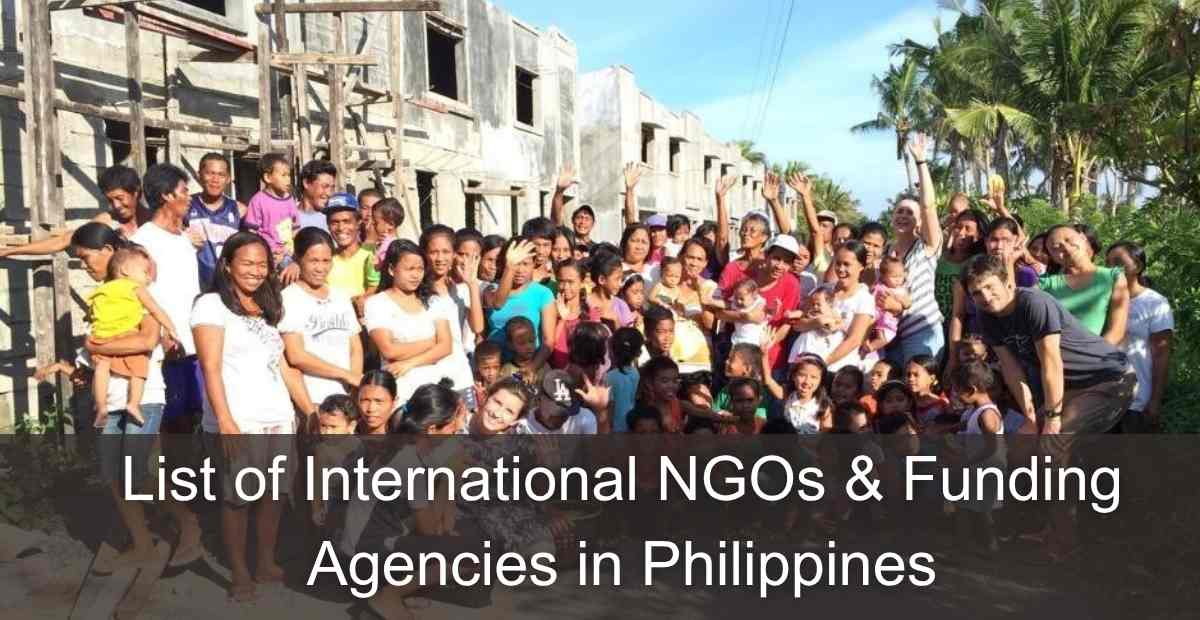
The Philippines faces a unique development paradox. While classified as a lower-middle-income country with a rapidly growing economy, it remains highly vulnerable to climate disasters—typhoons, earthquakes, and rising sea levels—while grappling with persistent poverty, especially in Mindanao and rural areas.
For local NGOs, people’s organizations, and civil society groups, international funding is not just helpful; it is often essential.
This guide provides the definitive, updated 2026 list of active international donors, multilateral agencies, and foreign foundations funding projects in the Philippines—from small grassroots grants to multi-million dollar development programs.
Top 10+ International NGOs & Funding Agencies in Australia (2026 Guide)
The Philippine Funding Landscape in 2026
International donors in the Philippines have shifted focus in recent years. The top priorities for 2026 are:
- Climate Resilience & Disaster Risk Reduction: With the country consistently ranking as the most disaster-prone in the world, donors like UNDP and Australia are heavily investing in local adaptation.
- Agriculture & Food Security: The World Bank recently approved a $1 billion loan to modernize Philippine agriculture.
- Digital Transformation & Connectivity: Expanding internet access in underserved areas (BARMM, Mindanao) is a major theme.
- Peacebuilding & Indigenous Peoples’ Rights: Especially in Bangsamoro Autonomous Region in Muslim Mindanao (BARMM) and Palawan.
- Sexual & Reproductive Health (SRHR): The EU has identified this as a priority gap.
Top 15+ International NGOs & Funding Agencies in the Philippines
We have categorized the donors below by their accessible funding windows. Note that some (like the World Bank) primarily fund the Government, while others (like EU, Japan, Canada) offer direct grants to NGOs.
1. Multilateral & UN Agencies (Large Grants)
| Donor Agency | Focus for 2026 | Grant Size | How to Apply |
| World Bank (WB) | Agricultural modernization, SME competitiveness, Digital infrastructure (BARMM). | $1M+ (Govt focused). For NGOs: Look for “GFPP” calls. | Monitor the Procurement & Grant notices on WB Philippines. |
| European Union (EU) | Social protection, Digital transition, Infrastructure, Sexual & Reproductive Health (SRHR) . | ₱50M – ₱120M (EUR 800k to 2M). | EU Funding & Tenders Portal. |
| United Nations Development Programme (UNDP) | Disaster resilience (SHIELD Programme), Climate adaptation, Fisheries (Basilan). | **Up to 30,000∗∗(LowValueGrants)to30,000∗∗(LowValueGrants)to800M+ (Program level). | UNDP Philippines “Procurement Notices” page. Closed calls publish new cycles. |
| International Finance Corporation (IFC) | Sustainable infrastructure, Decarbonization, Renewable energy (Private sector focus). | $25M+ (Equity/Infrastructure). | Rarely direct cash grants; partnership opportunities for large CSOs. |
2. Bilateral Government Agencies (Direct Access for NGOs)
| Donor Agency | Focus for 2026 | Grant Size | How to Apply |
| Government of Japan (GGP) | Grassroots human security: Fishing facilities, solid waste management, medical equipment. | ₱4.3M to ₱18M (75k−75k−318k). | Embassy of Japan in the Philippines (GGP Program). Highly recommended for provincial LGUs. |
| Government of Canada (CFLI) | Peacebuilding, Gender equality, Human rights, Good governance (ASEAN region). | ₱1.3M – ₱6.5M (CAD 20k – 100k). | Status: OPEN. Global Affairs Canada portal. |
| Australian Government (DFAT) | Disaster resilience, Climate adaptation (SHIELD Programme). | AUD 20M over 8 years (National program). | Implemented via UNDP. Partnership bids via DILG. |
3. International Foundations & Private Trusts
| Donor Agency | Focus for 2026 | Grant Size | How to Apply |
| Imai Memorial Overseas Cooperation Fund (Japan) | Education, Healthcare, Livelihoods for children in poverty, Minorities, Disabilities. | ₱350k – ₱700k (JPY 500k – 1M). | Open to Japanese-registered NGOs working in PH. Requires a local partner. |
| Foundation for the Philippine Environment (FPE) | Biodiversity, Indigenous Peoples’ rights, Watershed management (Mindanao, Visayas). | Small to Large grants (₱500k – ₱5M+). | FPE Website (Partners Page). Active local grantmaker. |
| Canada Fund for Local Initiatives (CFLI) | Small-scale, high-impact projects aligned with Canadian priorities. | Up to ₱6.5M (CAD 100k). | OPEN for 2026. Mission of Canada to ASEAN. |
3 Active Funding Opportunities in Philippines Right Now (2026)
1. Buffett Grants
- Status: Open
- Budget: $5,000 – $1,000,000
- Who can apply: Philippine NGOs, academic institutions, community groups.
- Focus: Agricultural projects, Tech, Startup, gender equality, community development NGOs, Skills acquisition initiatives.
2. The Canada Fund for Local Initiatives (CFLI) – ASEAN
- Status: Open
- Budget: CAD 20,000 – 100,000 (₱1.3M – 6.5M)
- Who can apply: Philippine NGOs, academic institutions, community groups.
- Focus: Environment and climate action, gender equality, human rights, peace and security.
2. Japan’s Grant Assistance for Grassroots Human Security Projects (GGP)
- Status: Rolling (Call for proposals announced March 2026)
- Recent example: ₱4.38M for fishing communities in Palawan and ₱14M for waste management in Bohol.
- Focus: Primary healthcare, water supply, vocational training, infrastructure for marginalized groups.
3. EU Call for Proposals (Nkulanawe Initiative)
- Status: Deadline just passed (April 6, 2026) – Watch for next cycle.
- Themes: Social protection, Digital transition, Infrastructure, SRHR.
- Grant Sizes: €500,000 up to €2,000,000.
- Insight: This is the “whale” of Philippine funding. Prepare your consortium now for the 2027 re-opening.
Detailed Donor Profiles: How to Apply
World Bank: The Infrastructure Giant
While the World Bank typically lends to the government (e.g., the recent $1 billion loan for agriculture ), NGOs are often brought in as Implementing Partners.
- Recent Grants (2026): $4.13 million approved for DA, DTI, and DICT projects.
- Advice: Get accredited with the Department of Agriculture (DA) or DILG. The World Bank pays for service delivery, not advocacy.
United Nations Development Programme (UNDP): The Climate Leader
UNDP is currently the most active UN agency in the Philippines regarding direct access for NGOs.
- Case Study: The SHIELD Programme (funded by Australia) is helping Pangasinan use drones and AI for disaster prep.
- Opportunity: They recently issued a call for “Low Value Grants” (up to $30k) for sustainable fisheries in Basilan.
Japan (GGP): The Grassroots Champion
Unlike Western donors who often require complex logical frameworks, the Japanese GGP is relatively administrative-light for small infra projects. They prioritize tangible results (a building built, boats purchased).
European Union: The Large-Scale CSO Funder
The EU requires consortiums. You rarely apply alone. You must partner with 2-3 other Filipino or European NGOs to qualify for the €1M+ grants.
Frequently Asked Questions (FAQs)
1. Can a small, newly registered NGO in the Philippines apply for international funding?
Yes, but with limits. The Buffett Grants and Japan (GGP) are open to smaller groups. However, the EU and World Bank usually require 3+ years of audited financials. The Imai Fund actually prefers smaller NGOs (annual income under JPY 30M / ₱12M).
2. Is it easier to register as a Philippine SEC or NGO to get these grants?
You can apply as either. Most donors (EU, Canada) accept both SEC-registered NGOs and government-accredited CSOs. You must have a PCNC Certificate (Philippine Council for NGO Certification) for tax exemptions, though not all donors require it for application.
3. What is the difference between a “Grant” and a “Loan”?
- Grant: Free money (e.g., Japan GGP, Canada CFLI, EU Grants).
- Loan: Borrowed money that must be paid back (e.g., World Bank loans to the National Government or IFC loans to private businesses).
- Advice for NGOs: Stick to the Grant programs listed above.
4. How do I access the $1 Billion World Bank loan for agriculture?
You cannot access the loan directly. The money goes to the Department of Agriculture (DA) . Your NGO can submit a concept note to the DA to become a “Service Provider” for training or distribution of seeds/supplies under the PSAT project.
5. Are there specific funds for Indigenous Peoples (IPs)?
Yes.
- FPE (Foundation for the Philippine Environment) actively funds IP-led conservation projects in Mindanao.
- Japan GGP funded the UCCP to support Indigenous fishing communities in Palawan.
6. My NGO is in Mindanao (BARMM). Where should I focus?
Digital and Peacebuilding. The World Bank has specific grants for “Digital Infrastructure Project Scale-up” targeting Western Mindanao and BARMM. Also, look for peacebuilding funds from Global Affairs Canada.
The Ultimate Application Checklist
Before you email any donor, ensure you have this “Philippine Compliance Package” ready:
- SEC Registration Certificate (or DSWD License for Social Welfare).
- PCNC Certificate (for tax exemption/donor deductibility).
- Audited Financial Statements (last 2-3 years).
- Accreditation from Government Agency (e.g., DILG, DA, DepEd) – Crucial for World Bank/EU.
- Certificate of No Derogatory Record (from SEC or DSWD).
- Bank Account capable of receiving Foreign Currency (USD/EUR/JPY/CAD) – Not all rural banks have this.
Conclusion
The funding environment in the Philippines for 2026 is robust, particularly in climate resilience, agriculture, and digital inclusion. While the large loans make headlines, the most accessible funding for local NGOs remains the Buffett Grants and the Canada Fund for Local Initiatives (CFLI) .
Your Strategy:
- Start small: Apply for the Buffett Grants 50k – 100k Canada Fund or the ₱4M Japan grant.
- Partner up: For EU money, don’t go alone.
- Quantify your impact: Donors want data on typhoon resilience and poverty reduction.
Top 30+ International NGOs & Funding Agencies in South Africa (2026 Guide)